The text that sat on “read” for three hours
It is 7:40 pm. Ana sent a message at lunch: “Can we talk tonight? Something felt off this morning.” Leo saw it, felt his chest tighten, and put the phone face down. By evening Ana has sent four more messages. Leo has sent none.
When he finally walks in, she asks why he went silent. He says he was busy. She says that is not true. He goes quiet, then goes to the gym. An hour later he sends a heart emoji, she feels a wave of relief, and two days later it all happens again.
This is what an anxious avoidant relationship looks like. If that scene feels familiar to you as a couple, you may be in one. It is one of the most common patterns couples fall into, and one of the most fixable once both partners can see it.
In this guide for couples you get attachment basics in plain words, the cycle step by step, ten signs, what each partner really feels, moves for both of you, scripts and an honest answer on whether the relationship can work.
Attachment styles, without the textbook
What do attachment styles actually mean?
Attachment styles are the habits we use to stay close to the people we depend on. They form early, when we learn whether comfort comes reliably, unpredictably or rarely. As adults, couples bring those habits into the relationship, mostly without noticing. They are patterns, not fixed personalities, and they shift with experience.
The idea started with John Bowlby, who studied how children bond with caregivers. Mary Ainsworth then observed toddlers being briefly separated from a parent and reunited. Some settled quickly, some clung and protested, some acted as if they did not care.
In 1987 Cindy Hazan and Phillip Shaver showed that adults in couples show the same broad styles. Here they are without the textbook:
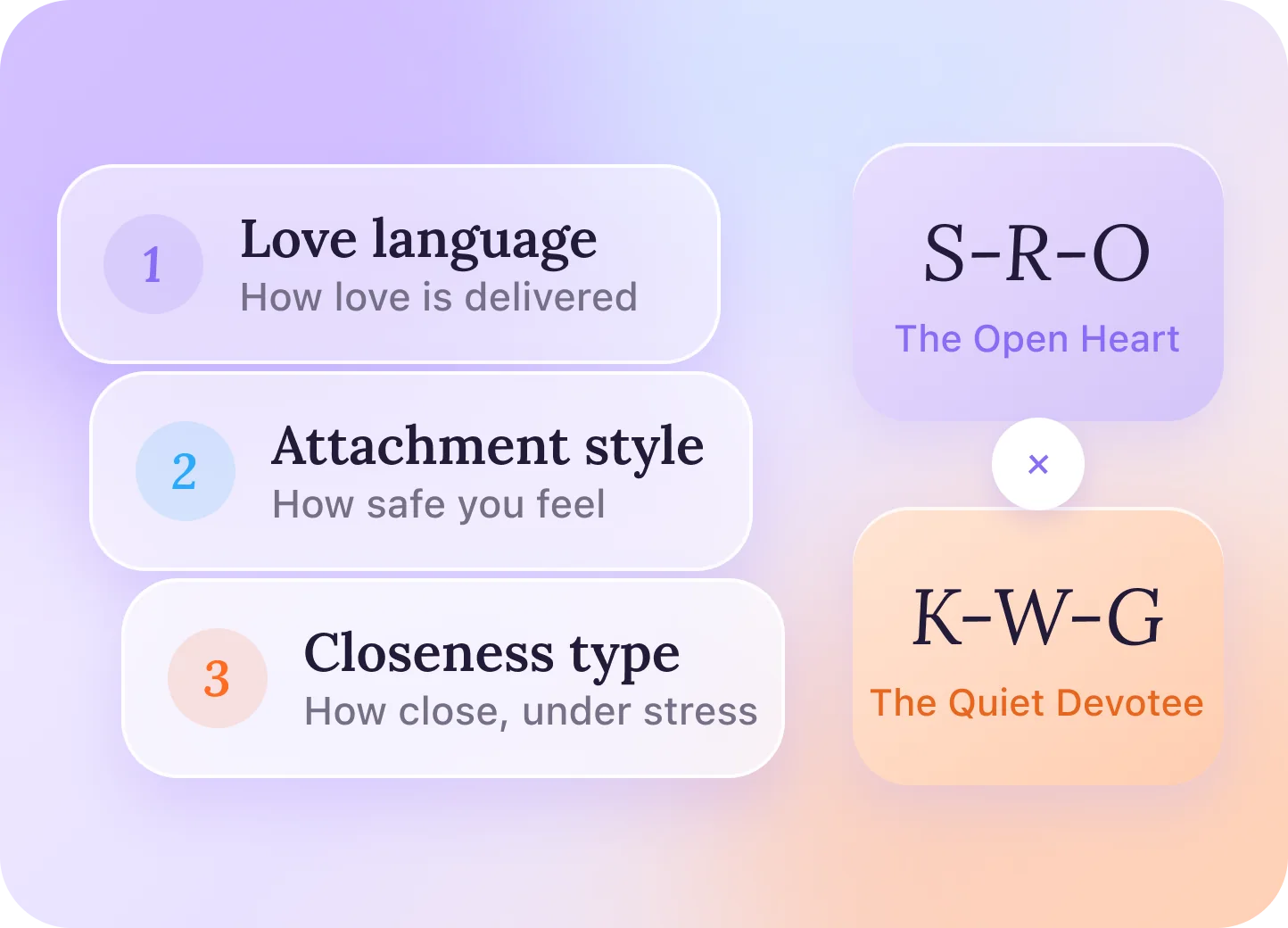
Most people, and most couples, are a blend. If you want to see how this fits with love languages, our post Your Relationship Profile: How Love Languages, Attachment Styles and Closeness Types Fit Together walks through all three layers together.
Why does an anxious avoidant relationship start so easily?
Anxious and avoidant partners often attract because each one feels familiar to the other. The avoidant partner’s calm independence can feel steady and intriguing. The anxious partner’s warmth and pursuit can feel flattering and alive. Each strategy also fits the other’s expectations, so the pull feels like chemistry.
Amir Levine and Rachel Heller popularised the phrase “anxious avoidant trap” in their book Attached. Their point is simple: in an anxious avoidant relationship, the two styles confirm each other’s fears. The anxious partner learns that love is uncertain. The avoidant partner learns that closeness means pressure.
There is also a complementary logic. One partner reaches, the other regulates by stepping back. In calm weeks the pair can feel balanced. Under stress, the same moves lock together and the anxious avoidant trap closes on the couple.
How does the anxious avoidant cycle work?
The anxious avoidant cycle is a loop where distance triggers pursuit, pursuit triggers withdrawal, and withdrawal triggers more pursuit. In most couples, neither partner is the villain. Each move is a reasonable attempt to feel safe that happens to make the other person feel less safe. Seeing the steps is the first real step out.
Family researchers have long called this the pursuer distancer pattern. Here is how it usually runs in couples:
- 1Distance appearsA busy week, a short reply, a cancelled plan. Something small creates a gap.
- 2The anxious partner pursuesMore messages, more questions, a request to talk now.
- 3The avoidant partner withdrawsThe pursuit feels like pressure, so they go quiet, get busy or change the subject.
- 4The anxious partner protestsPursuit turns into criticism or tears: “You always do this.”
- 5The avoidant partner shuts downThey stonewall, leave the room or go cold to stop feeling flooded.
- 6A brief repairSomeone softens, there is relief, maybe affection. Nothing underneath has changed.
- 7RepeatThe next small gap starts the loop again, a little faster each time.
The cruel part of the pursuer distancer loop for a couple is that each partner’s fix is the other’s trigger. The more one reaches, the more the other retreats, and the reverse.
10 signs you are in the pursue-and-withdraw loop

The clearest sign is a repeating loop: one partner asks for more closeness, the other asks for more space, and the same fight replays with different topics. If several of the signs below sound familiar, you are probably not an incompatible couple. You are probably in an anxious avoidant relationship, a pattern that has a name and a way out.
- 1The topic changes, the fight does notDishes, texts, weekend plans: the shape of the argument is always the same.
- 2One of you counts response timesA slow reply feels like a message in itself.
- 3One of you needs to “think” for daysAnd the other experiences those days as punishment.
- 4Reassurance helps, but only for a whileThe relief fades and the worry returns.
- 5Closeness after a good weekend is followed by distanceIntimacy seems to trigger a step back.
- 6Conversations get cut off mid-sentenceOne partner leaves the room, the other follows.
- 7You both feel lonely, even as a coupleOur post on Feeling Lonely in a Relationship covers this feeling in depth.
- 8You trade labels“Needy” and “cold” get thrown both ways.
- 9Repairs are quick but shallowYou make up as a couple without ever talking about what happened.
- 10Each half of the couple feels like the one doing all the workOne works at connecting, the other works at keeping the peace.
What is each partner really feeling underneath?
Underneath the anxious avoidant cycle, both partners usually feel the same thing: fear of losing the connection. They just protect it in opposite ways. The anxious partner protects it by reaching. The avoidant partner protects it by stepping back so the conflict does not destroy it.
| The anxious partner | The avoidant partner | |
|---|---|---|
| What they do | Texts more, asks to talk now, checks for signs, protests or criticises | Goes quiet, changes the subject, gets busy, leaves the room |
| What they feel | Scared of being left, unimportant, invisible | Flooded, criticised, afraid of failing their partner |
| What they tell themselves | “If I stop reaching, we will drift apart.” | “If I stay in this, I will say something that makes it worse.” |
| What they need | Predictability, warmth, a clear sign they still matter | Calm, time to process, trust that space is not rejection |
| What helps most | A partner who leaves with a promise to come back | A partner who can wait without escalating |
Sue Johnson, who developed Emotionally Focused Therapy, describes these fights as protests against disconnection. Both partners are really asking the same question: are you there for me? Seeing that helps a couple turn an enemy back into a teammate.
How to break the anxious avoidant cycle

Breaking the cycle means each partner changes their own move first, then the couple builds small, predictable rituals together. You do not have to change your attachment style overnight. You only need to interrupt the loop early enough that it never reaches the shutdown stage. These steps answer how to make an anxious avoidant relationship work in daily life.
For the anxious partner: 6 concrete moves
- 1Name the feeling before the request“I feel disconnected” lands softer than “Why are you ignoring me?”
- 2Send one message, then waitOne clear text beats five escalating ones.
- 3Self-soothe firstA walk, a shower, a call with a friend. Calm your body before you reach for your partner.
- 4Ask for specific reassurance“Can you tell me we are okay?” is easier to give than “Show me you care.”
- 5Notice the reassurance you already getWrite down three things your partner did this week that showed care.
- 6Respect the pauseIf they promise to come back, let them. Following them into the next room restarts the loop.
For the avoidant partner: 6 concrete moves
- 1Never disappear without a time“I need an hour, then I want to talk” turns withdrawal into a pause.
- 2Say one feeling out loudEven “I feel overwhelmed” gives your partner something real instead of silence.
- 3Come back when you said you wouldKeeping this promise builds more trust in the relationship than any big gesture.
- 4Offer reassurance before it is asked forA midday “thinking of you” costs ten seconds and prevents the first step of the cycle.
- 5Stay a little longer than is comfortableFive more minutes in a hard talk teaches your nervous system it can survive it.
- 6Notice your exit habitsMake one of them a conscious choice, not an escape.
Together: rituals that make the loop predictable
Scripts for both partners
Scripts help because the anxious avoidant cycle moves faster than thought. Having a sentence ready lets you choose a new move in the second when the old one would usually fire. Adapt the words so they sound like you, then practise them once as a couple when things are calm.
 Instead of“Why are you ignoring me again?”
 Try“I am feeling a bit disconnected today. Can we have ten minutes tonight?”Instead of(silence, leaves the room)Try“I am getting overwhelmed. I need twenty minutes, and then I want to finish this.”Instead of“Fine, go, you always leave.”Try“Okay. I will be here at 8. Thank you for telling me when.”Instead of“Can we just forget it?”Try“I am back. I think what upset me was feeling criticised. What was it like for you?”Instead of“You are so needy / so cold.”Try“I think we are in the loop again. Can we step out of it together?”
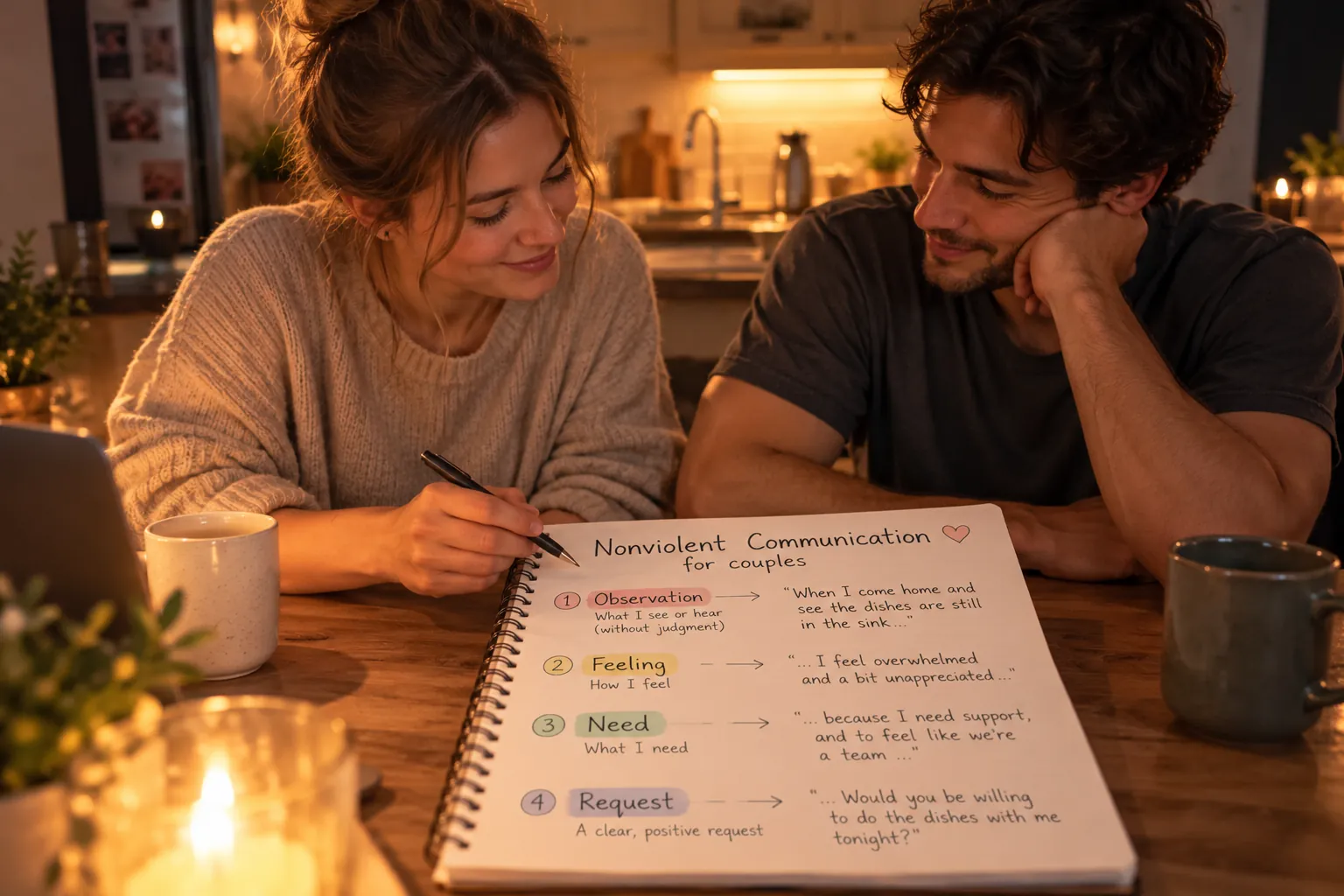
For more structure, the four steps in Nonviolent Communication for Couples (observation, feeling, need, request) work well for couples with either style.
Can an anxious and avoidant relationship work?
Yes, an anxious and avoidant relationship can work, but only if both partners see the pattern and both take responsibility for their half. It will not work if one partner does all the adjusting, or if withdrawal turns into contempt. For couples, honest effort from both sides matters far more than starting compatibility.
What is earned security?
Attachment researchers use the term “earned security” for people who started anxious or avoidant and became more secure over time. Steady, responsive relationships are one of the main ways that happens. Each time a promise is kept, the nervous system updates a little.
So the question “can an anxious and avoidant relationship work” has a hopeful answer for most couples. A pair who keeps showing up predictably can both move toward secure, together.
When does an anxious avoidant relationship not work?
Be honest as a couple here. It is unlikely to work if one partner refuses to acknowledge the pattern at all. It is not a healthy relationship if silence is used as punishment, or if pursuit turns into control, threats or monitoring.
When should you get professional support?
Seek a qualified professional if the cycle is escalating, if either partner feels afraid, or if past trauma keeps surfacing. Someone trained in Emotionally Focused Therapy, the approach developed by Sue Johnson, works with couples caught in exactly this loop. An app is not a replacement for professional help.
How 4couple helps with the anxious avoidant cycle
4couple is an AI relationship app for couples that names the pursue-and-withdraw loop before the fight and gives each partner a calm way to ask for closeness or space. Once you are paired with your partner using a pairing code, these features fit couples in this pattern directly.

Connection Type quiz and your partner combo
The Connection Type quiz is six statements, and each partner in the pair takes it separately. It reads three axes: Closeness (Secure or Seeking), Conflict (Reacher or Retreater) and Expression (Open or Guarded). A Seeking Reacher who shares freely might be The Wholehearted. A Seeking Retreater who goes quiet under stress might be The Quiet Devotee.
Paired together, The Wholehearted and The Quiet Devotee are the classic loop, and the couple’s combo card says so in warm language before the next fight. The app never shows “anxious” or “avoidant” labels. Your Connection Type plus your love language make up your Relationship Profile.

Signals for space and closeness
Signals are one-tap messages between paired partners. “I need a little space” lets the avoidant partner ask for room without disappearing. “I need a hug” lets the anxious partner ask for reassurance without protest. “I want to feel closer tonight” turns a vague worry into a clear, kind request.
Partner Chat instead of silence
In Partner Chat, your partner sees “your partner is working on their reply” rather than a blank screen. For an anxious partner, that small status replaces three hours of guessing. Your first message is shaped by Translate My Emotions and approved by you before your partner sees a short neutral topic card plus your words.

Translate My Emotions for protest messages
Paste the raw message you want to send at 11 pm, the one that starts “You always…”. Translate My Emotions gives back a 2-4 sentence version in your own voice: what happened, how you feel, what you need and a request. You can copy it, edit it or ask for softer. It never sends for you.

Daily mood check-in as a reassurance ritual
The daily mood check-in takes a few seconds for both partners in a paired couple. You see how your partner feels without having to ask, which is a low-pressure reassurance ritual for anxious partners and a no-talk way to share for avoidant ones. Over weeks the couple can track patterns, like which days the loop tends to start.

AI Companion for the moments in between
The AI Companion is a private chat that is never visible to your partner. Use it to calm down before reaching out, or to work out what you are actually feeling before coming back from a pause. If a Partner Chat message stung, “Discuss this message” takes it into your AI Companion first.
What we deliberately do not do. We never show clinical labels like anxious or avoidant inside the app. Nothing is ever sent for you. Nothing from either partner’s private AI Companion conversations ever appears to the other partner. 4couple is not a replacement for professional help.
Frequently asked questions
What is an anxious avoidant relationship?
It is a pattern where one partner tends to seek closeness and reassurance while the other tends to need space and independence, especially under stress. Their strategies trigger each other, creating a repeating cycle of pursuit and withdrawal. It is a common pattern between partners, not a sign that either person is broken or that the couple is doomed.
What is the anxious avoidant trap?
The anxious avoidant trap is a phrase popularised by Amir Levine and Rachel Heller in their book Attached. It describes how anxious and avoidant partners often attract each other and then confirm each other’s fears. The anxious partner learns love is unreliable, while the avoidant partner learns closeness means pressure, and the couple feels stuck in the same loop.
How do you break the anxious avoidant cycle?
Each partner changes their own move first. The anxious partner sends one calm message and self-soothes before pursuing. The avoidant partner never withdraws without a return time. Together, the couple uses a pause with a promise, scheduled check-ins and small reassurance rituals, and names the cycle as the shared enemy rather than blaming each other.
Can an anxious and avoidant relationship work?
Yes, if both partners recognise the pattern and both work on their half of it. Researchers describe “earned security,” where people become more secure through steady, responsive relationships. It is unlikely to work if only one partner adjusts, or if silence becomes punishment or pursuit becomes control. In couples, effort from both partners matters more than starting styles.
Is there an app that helps couples in an anxious avoidant relationship?
Yes. 4couple is an AI relationship app for couples that names the pursue-and-withdraw loop before the fight and gives each partner a calm way to ask for closeness or space. Paired couples get a Connection Type combo card, one-tap signals like “I need a little space,” a daily mood check-in, and Translate My Emotions for messages written in the heat of the moment.
Can someone with avoidant attachment change?
Yes. Avoidant attachment is a learned strategy, not a fixed trait. With a partner who respects space and a steady routine of keeping promises, many people gradually feel safer staying present. Small moves, like naming one feeling or returning when you said you would, slowly teach the nervous system that closeness is not a threat.
When should we see a professional?
Seek a qualified professional if the cycle is escalating, if either partner feels afraid, if there is control, threats or monitoring, or if past trauma keeps coming up. A specialist trained in the Emotionally Focused approach developed by Sue Johnson works with exactly this loop. Apps and articles can support a couple, but they are not a replacement for professional help.
The research and frameworks behind this article, and where to read more:
- Cindy Hazan and Phillip Shaver (1987): Romantic Love Conceptualized as an Attachment Process, Journal of Personality and Social Psychology. The study that applied attachment theory to adult couples.
- Amir Levine and Rachel Heller: Attached. The book that popularised the anxious-avoidant trap.
- Center for Nonviolent Communication: cnvc.org. The organisation founded by Marshall Rosenberg, author of Nonviolent Communication: A Language of Life.
- Gary Chapman: The 5 Love Languages. The official site for the five love languages.
- International Centre for Excellence in Emotionally Focused Therapy: What is EFT?. The approach developed by Sue Johnson, author of Hold Me Tight.
This article is general information, not therapy or medical advice. 4couple is a relationship app, not a replacement for a qualified professional. If you feel unsafe in your relationship, contact a professional or your local support line.

Writes about everyday relationship communication and how couples use 4couple day to day.

Turns relationship research into practical guides couples can use the same evening.