15 exercises for couples therapy you can try at home, from Gottman, EFT, Imago and NVC, with steps and a 4-week plan for your relationship.
16 min readExercisesCommunication
Written by Masha Maksymovych and Yuliana RudayaPublished
Exercises
Therapy homework for your living room.
The quiet Tuesday problem
It is half past nine on a Tuesday evening. The dishes are done, the pair of you are on the sofa, and both phones are out. Nobody is fighting, but you cannot remember your last real conversation that was not about groceries.
That gap is exactly what exercises for couples therapy are designed for. Counsellors and relationship researchers have spent decades testing small, structured habits that help couples talk, listen, repair and feel close again. Many are simple enough to try at home tonight.
This guide collects 15 well-known couples therapy exercises, where each comes from, and how to do it step by step. You also get a 4-week plan, ideas for a reluctant partner, and an honest section on when home practice is not enough.
One thing first: these exercises are not a replacement for professional help. They are the kind of couples therapy homework a good counsellor might suggest between sessions, made practical for a normal week.
What are exercises for couples therapy, and do they work at home?
Exercises for couples therapy are short, structured activities that counsellors give couples to practise between sessions: new ways of talking, listening, repairing and showing appreciation. Most come from published work by John Gottman, Sue Johnson, Harville Hendrix and Marshall Rosenberg. Many work well at home, as long as both partners feel safe.
Think of them like physio for a relationship: a few minutes, repeated for weeks. Pick one or two at a time, put phones away and do not keep score.
Not sure where to begin? This quick guide matches common gaps to the exercises for couples therapy in the list below:
What feels off
Try first
Time needed
Small talks turn into fights
Softened start-up (4), speaker-listener (1)
1-20 minutes
You feel like flatmates
Love maps (6), stress-reducing conversation (5)
20-30 minutes
The same fight keeps looping
Hold Me Tight conversations (9), state of the union (10)
30-60 minutes
Little warmth or thanks
Fondness and admiration list (11), gratitude journal (12)
2-15 minutes
Touch and fun have faded
Six-second kiss (13), love language exercise (15)
Under 10 minutes
15 couples therapy exercises you can do at home
The 15 exercises below are grouped into five areas: communication, connection, conflict and repair, appreciation, and intimacy and fun. Each one covers what it is, where it comes from, the steps, how long it takes and what it gives your relationship. Start with the group that matches the gap you feel most as a couple.
Communication exercises for couples
Most arguments are about one partner not feeling heard. These four communication exercises for couples change how you talk before they change what you talk about.
1
The speaker-listener technique
What it is: One partner speaks, the other paraphrases, then you swap. It comes from PREP, the relationship education program developed by Howard Markman and Scott Stanley.
Pick a small, real topic and an object (the TV remote) to act as “the floor”.
Whoever holds the floor speaks in short “I” statements.
The listener paraphrases without rebutting: “So what you’re saying is…”
Swap. Only problem-solve once you both feel heard.
Time and payoff: 15-20 minutes. It slows a hot topic down enough for each partner to actually hear the other.
2
Imago mirroring dialogue
What it is: A dialogue of mirroring, validating and empathising, from Imago Relationship Therapy, created by Harville Hendrix and Helen LaKelly Hunt.
The sender shares one feeling or concern in a few sentences.
The receiver mirrors: “Let me see if I got that. You said… Is there more?”
The receiver validates: “That makes sense to me, because…”
The receiver empathises: “I imagine you might be feeling…” Then switch roles.
Time and payoff: 20-30 minutes. Your partner hears their own words back and feels understood.
3
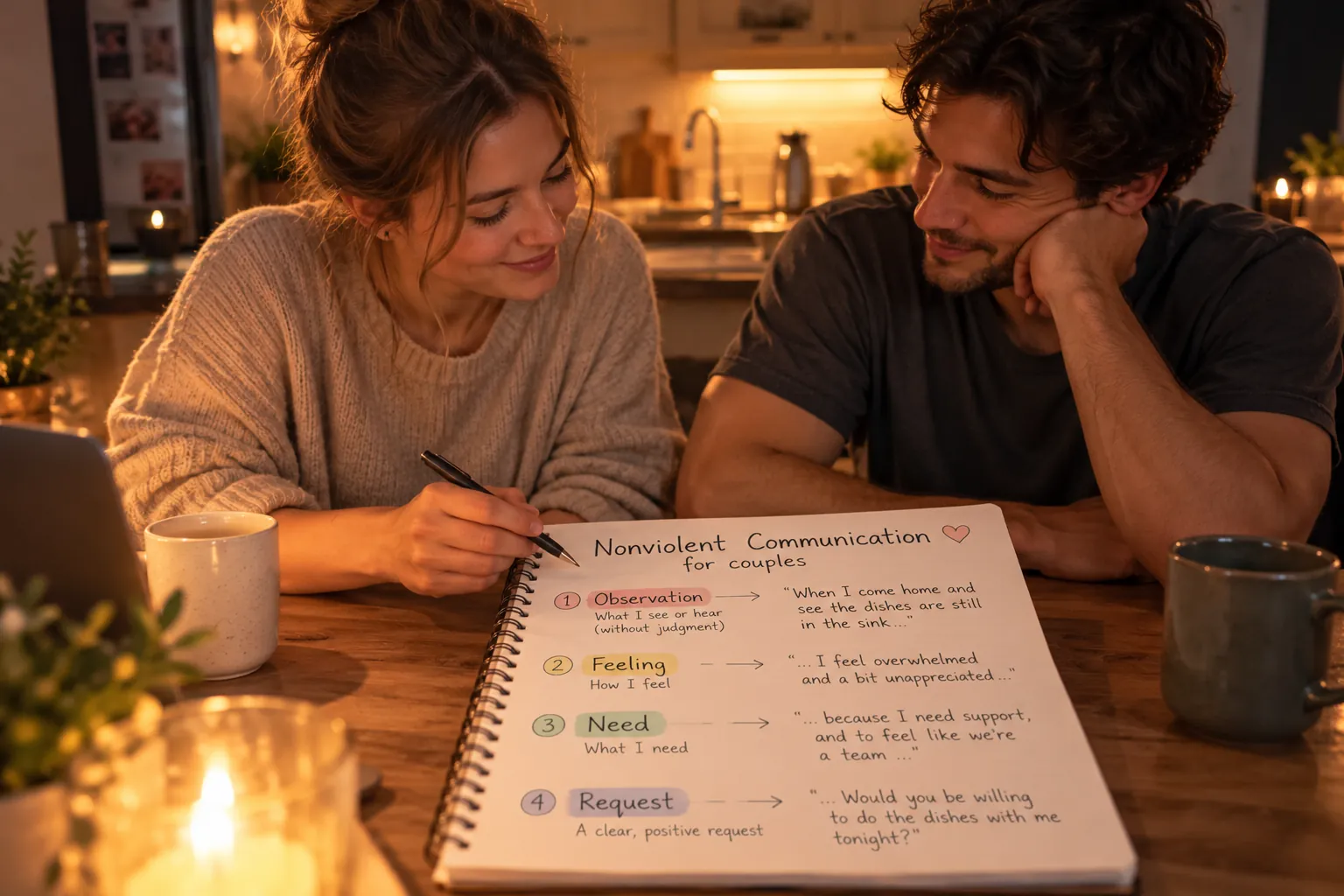
The NVC four steps
What it is: Marshall Rosenberg’s Nonviolent Communication in four steps: observation, feeling, need and request. We cover it in depth in Nonviolent Communication for Couples.
Observation: “You were on your phone during dinner.”
Feeling: “I felt lonely.”
Need: “I need some time where we are fully with each other.”
Request: “Could we keep phones off the table this week?”
Time and payoff: Five minutes. It turns a complaint into a request your partner can say yes to.
4
The softened start-up
What it is: A gentler way to open a hard topic. Gottman’s research found that the way a conflict conversation starts strongly predicts how it ends.
Start with “I”, not “you”.
Describe the situation, not your partner’s character.
Say what you need, in positive terms.
Add a true appreciation: “I’m stressed about the bills. Could we go through them on Sunday? You’re better at this than me.”
These four relationship building exercises keep the everyday friendship current.
5
The stress-reducing conversation
What it is: A daily chat about stress from outside the relationship, such as work, family or health. It comes from John Gottman’s work on protecting a couple’s friendship.
Set aside 20-30 minutes, ideally soon after work.
Talk only about outside stress, never about each other.
The listener stays curious and takes their partner’s side, with no unasked-for advice.
Close with: “That sounds exhausting. I’m on your side.”
Time and payoff: 20-30 minutes a day. Outside stress stops leaking into the couple.
6
Love maps
What it is: Gottman’s term for how well you know your partner’s inner world: worries, hopes, friends and current favourites.
Each of you writes ten questions about the other: “Who is your closest work friend right now?”
Take turns. Guess first, then hear the real answer.
Repeat monthly with new questions for couples, or borrow from 100 Deep Questions to Ask Your Partner to Feel Closer.
Time and payoff: 20 minutes. You keep knowing the person you live with now.
7
Turning toward bids
What it is: A “bid” is any small attempt to connect: a comment, a joke, a sigh, a touch. Gottman’s research found that couples who stay together turn toward bids far more often than couples who split up.
For one week, both of you notice bids, like “Look at this” or a hand on your shoulder.
Respond to each one, even briefly: eye contact, a smile, “Huh, really?”
Each evening, name one bid you noticed from your partner.
At the week’s end, talk about which bids matter most to each of you.
Time and payoff: No extra time, just attention. Small moments add up to feeling seen.
8
Arthur Aron’s 36 questions
What it is: Three sets of questions that get more personal as you go. Psychologist Arthur Aron and colleagues published them in 1997, in a study on building closeness between strangers.
Take turns, both partners answering each question in order.
Do one set per evening if all three feels like a lot.
Do not skip the uncomfortable ones. They are the point.
Time and payoff: Around an hour.
Conflict and repair exercises
Every couple fights. What matters is repairing afterwards.
9
Hold Me Tight conversations
What it is: Seven guided conversations from Dr Sue Johnson’s book Hold Me Tight, based on Emotionally Focused Therapy (EFT). They help couples spot their negative cycle and reach for each other instead.
Take one conversation per week, starting with the first.
Name your “demon dialogue”, the loop you fall into, such as one pursues and one withdraws.
Make the loop the shared enemy: “It’s us against the pattern.”
Each say what you feel underneath the anger, such as fear of not mattering.
Time and payoff: 30-45 minutes each. You stop fighting each other and start fighting the cycle.
10
The weekly “state of the union” meeting
What it is: A weekly check-in on how the relationship is going, recommended by John and Julie Gottman.
Pick a fixed weekly slot, such as Sunday evening.
Open with five things you appreciated about your partner this week.
Raise one issue each, using a softened start-up.
Listen to understand before trying to solve.
Close with: “What can I do to make you feel loved this week?”
Time and payoff: About an hour. Small issues get aired before they grow.
Appreciation exercises
Appreciation changes the mood between two people fastest. These two couples therapy activities make it a habit.
11
The fondness and admiration list
What it is: Gottman describes fondness and admiration as a strong antidote to contempt. This exercise makes it concrete.
Each of you writes three qualities you admire in your partner.
Next to each, write one real moment you saw it.
Read the lists aloud to each other, slowly.
Time and payoff: 15 minutes. It reminds you both why you chose each other.
12
The gratitude journal
What it is: A daily note of one thing your partner did that you are grateful for. It draws on research showing that expressed gratitude strengthens close relationships.
Pick a format: a shared note, a notebook on the counter, a message thread.
Write one specific thing each day: “Thanks for walking the dog in the rain.”
Re-read the week together on Sunday.
Time and payoff: Two minutes a day. You train yourself to notice what goes right.
Intimacy and fun exercises
These three bring touch and play back, and double as easy date night ideas.
13
The six-second kiss and the 20-second hug
What it is: Two small rituals Gottman often recommends for reconnecting at the start and end of the day.
Agree on the moments: leaving in the morning and coming home.
Kiss for six seconds. Counting out loud is allowed.
Hug for 20 seconds, or until you both actually relax.
Time and payoff: Under a minute a day, and affection comes back.
14
Eye-gazing
What it is: Sitting face to face and holding eye contact without talking. It became widely known after a 2015 New York Times essay paired it with Aron’s 36 questions.
Sit knee to knee and set a two-minute timer.
Look into each other’s eyes. Laughing is fine.
Breathe slowly and notice what comes up.
Afterwards, each share one word for how it felt.
Time and payoff: 2-5 minutes. A fast way to feel present as a pair.
15
The love language exercise
What it is: Gary Chapman describes five love languages: words of affirmation, quality time, acts of service, receiving gifts and physical touch. The exercise is to practise your partner’s on purpose.
Write three specific actions that would make you feel loved.
Swap lists.
Do one item from your partner’s list every day for a week.
Time and payoff: Ten minutes to set up. You stop giving love in a language your partner does not speak.
A 4-week plan for couples exercises at home
A simple 4-week plan for couples exercises at home has one focus per week: communication, then connection, then appreciation, then repair. Each week pairs one small daily habit with one longer weekly session. It takes about 15 minutes a day plus an hour at the weekend, which fits most couples’ lives.
Week
Focus
Daily (5-15 minutes)
Weekly session (30-60 minutes)
Week 1
Talking without escalating
Six-second kiss; turning toward bids
Speaker-listener on one small topic
Week 2
Knowing each other again
Stress-reducing conversation
Love maps game, or one set of the 36 questions
Week 3
Appreciation
Gratitude journal
Fondness and admiration list, then your first state of the union
Week 4
Repair and depth
20-second hug; NVC for any complaint
Hold Me Tight conversation 1, plus the love language exercise
After week four, keep the state of the union meeting and your two favourite daily habits. A relationship needs a few habits you keep, not 15 you abandon.
What if one partner is reluctant to do couples therapy homework?
If one partner is reluctant, start small and drop the label. Many people hear “couples therapy homework” and assume it means something is broken. Invite them to a ten-minute experiment, start with a fun exercise, let them choose, and never use an exercise to win an argument.
Rename it“Want to try a question game tonight?” beats “We need to work on us.”
Start with playThe 36 questions or the love language exercise feel like fun, not homework.
Never correct their technique“You’re mirroring wrong” ends the experiment fast.
Do your half anywayTurning toward bids and appreciation work even if only one partner practises them, and often invite the other in.
When at-home exercises are not enough
At-home exercises help with everyday disconnection, not with serious harm. If your relationship involves recurring contempt, an affair, addiction, or any control, threats or violence, please see a qualified professional or contact a local support line. Exercises built on vulnerability can be unsafe when one partner does not feel safe.
Look for professional support if:
Contempt keeps coming backMockery, eye-rolling or name-calling, even after you have both tried to stop.
There has been an affair or major betrayalRebuilding needs a trained third person.
Addiction is involvedAlcohol, drugs, gambling or anything else taking over.
There is any control, threat or violenceDo not do vulnerability exercises with a partner who frightens you. Contact a local domestic abuse helpline, or emergency services if you are in danger.
The same fight has looped for monthsNothing shifts, however you phrase it.
One of you has had low mood or anxiety for weeksTalk to a doctor or a qualified mental health professional.
How 4couple helps you keep these exercises going
4couple is an AI relationship app for couples that turns well-known relationship exercises into short daily prompts both partners can do from their phones. Once you are paired in the app with a pairing code, the hardest part, remembering to do the exercise, gets easier.
“Let’s talk about” guided conversations: a built-in structure
“Let’s talk about” covers money, intimacy, family and in-laws, chores and the mental load, trust and jealousy, future plans, and personal space. Both partners answer the same questions privately, then read each other’s answers. Like the speaker-listener technique, each partner says their piece in full before the other responds.
Question of the day: love maps, daily
The question of the day is love maps in small doses. Both partners answer the same daily question, and you see your partner’s answer only after you answer. Over weeks, the pair of you rebuild a picture of each other’s inner world.
Translate My Emotions: a softened start-up on demand
Paste the raw message, say “You never help with anything,” into Translate My Emotions. You get a 2-4 sentence version in your own voice: what happened, how you feel, what you need and a request. Copy it, edit it or ask for softer. It never sends for you.
Partner Chat and “Discuss this message”
Partner Chat is a shared conversation for the paired couple. Your first message is shaped by Translate My Emotions and approved by you before your partner sees a short neutral topic card plus your words, with “Shape with AI” on the sender side. On the receiver side, “Discuss this message” takes a message that stung into your own AI Companion first, so you can calm down before replying.
Connection Type quiz and love language: know which exercises fit you
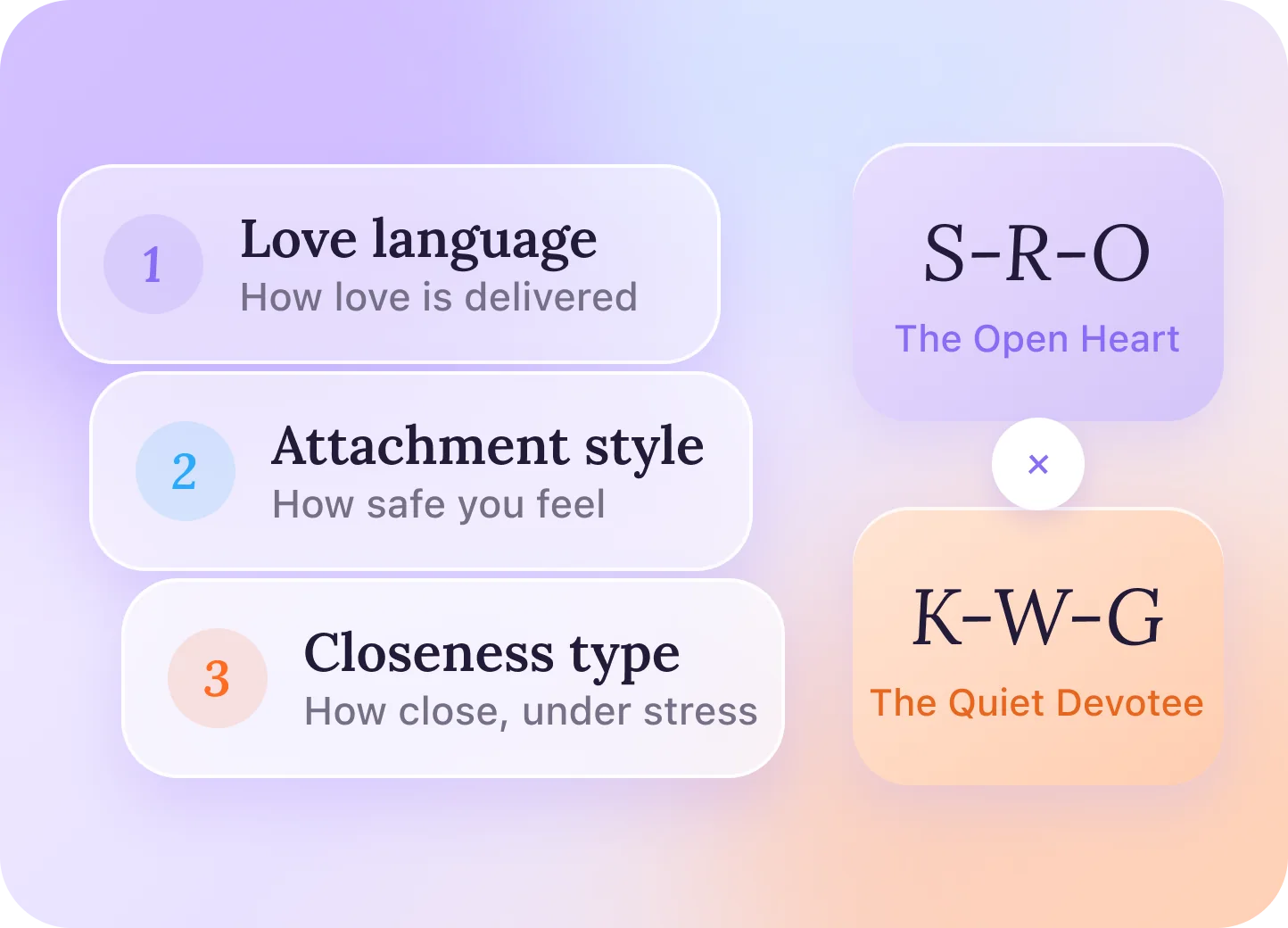
Each partner picks a love language in onboarding, and the shared reveal shows both. The Connection Type quiz is six statements that place you in one of eight types, such as The Steady Anchor or The Tender Pursuer. Together they form your Relationship Profile. It helps you pick exercises that suit you as a pair.
Daily mood check-in: your cue for the stress-reducing conversation
The daily mood check-in is a quick check-in for both partners. You see how your partner feels and can track patterns over weeks. If their mood check in shows a heavy day, that is your prompt for a stress-reducing conversation tonight. Home screen widgets can show your partner’s mood, your next date and countdowns.
What we deliberately do not do
4couple is a couples app, not a clinic.
We do not give you clinical labels, and the app never sends a message for you.
Nothing from either partner’s private AI Companion conversations ever appears to the other partner.
And no app is a replacement for professional help when a relationship needs it.
Frequently asked questions
What are the best exercises for couples therapy to do at home?
The most useful exercises for couples therapy at home are short and repeatable: Gottman’s stress-reducing conversation, love maps and softened start-up, the speaker-listener technique from PREP, Imago mirroring, and Rosenberg’s NVC four steps. For closeness, add Aron’s 36 questions and the love language exercise. Start with one or two per week, and keep sessions short.
What homework do couples therapists give?
Typical couples therapy homework includes a weekly relationship check-in, daily appreciation, listening exercises like mirroring, and rituals of connection such as a longer kiss or hug each day. Counsellors usually tailor homework to the couple’s own patterns, so a professional’s plan will fit better than any general list, including this one.
How often should we do couples therapy activities?
Little and often beats long and rare. Aim for one small daily habit, such as a six-second kiss or a gratitude note, plus one weekly session of 30-60 minutes. If an exercise still feels forced after two weeks, swap it for another rather than giving up on the idea altogether.
Can relationship building exercises work if only one partner joins?
Partly, yes. Turning toward bids, showing appreciation and using softened start-ups change the tone of a relationship even when only one partner practises them. Your partner often responds to the change before noticing the exercise. Paired exercises like mirroring need both of you, so start solo and invite them in later.
Are communication exercises for couples useful if we rarely fight?
Very. Many couples drift apart without fighting at all. Communication exercises for couples, like love maps or the stress-reducing conversation, are about staying close, not only about conflict. Quiet couples sometimes benefit the most, because distance can build without anyone noticing it.
Is there an app that helps couples practise exercises for couples therapy at home?
Yes. 4couple is an AI relationship app for couples that turns well-known relationship exercises into short daily prompts both partners can do from their phones. It includes a question of the day, a daily mood check-in, “Let’s talk about” guided conversations and Translate My Emotions. It is not therapy and does not replace a qualified professional.
When should we see a professional instead of doing exercises at home?
See a qualified professional if there is recurring contempt, an affair, addiction, or any control, threats or violence, or if the same fight has looped for months. Also reach out if either partner has had low mood for weeks. If you are in danger, contact emergency services or a local domestic abuse helpline first.
Sources and further reading
The research and frameworks behind this article, and where to read more:
Zach Brittle, The Gottman Institute: Turn Towards Instead of Away. John Gottman’s research on bids for connection and turning toward your partner.
Center for Nonviolent Communication: cnvc.org. The organisation founded by Marshall Rosenberg, author of Nonviolent Communication: A Language of Life.
Gary Chapman: The 5 Love Languages. The official site for the five love languages.
International Centre for Excellence in Emotionally Focused Therapy: What is EFT?. The approach developed by Sue Johnson, author of Hold Me Tight.
Imago Relationships Worldwide: imagorelationships.org. The Imago dialogue (mirroring, validating, empathising) created by Harville Hendrix and Helen LaKelly Hunt.
PREP Inc.: prepinc.com. The relationship education programme by Howard Markman and Scott Stanley behind the speaker-listener technique.
This article is general information, not therapy or medical advice. 4couple is a relationship app, not a replacement for a qualified professional. If you feel unsafe in your relationship, contact a professional or your local support line.
About the authors
Masha MaksymovychFounders Associate, 4couple
Writes about everyday relationship communication and how couples use 4couple day to day.
Yuliana RudayaHead of Organic Marketing, 4couple
Turns relationship research into practical guides couples can use the same evening.