How to be a better partner without grand gestures: 15 small daily habits couples can start this week, with example lines and a 2-week tracker.
15 min readHabitsCloseness
Written by Masha Maksymovych and Yuliana RudayaPublished
Habits
Small habits beat big gestures.
The anniversary dinner that did not fix anything
Sam booked the restaurant three weeks ahead. Flowers, a card, the good wine. Jess loved it. And on Monday, when Sam scrolled his phone through her story about a hard day at work, the glow was gone.
Most couples think the answer to how to be a better partner is a bigger gesture. It rarely is. What a partner remembers is whether you looked up when they spoke, kept the small promise, and said goodnight warmly after an argument.
This guide to how to be a better partner gives you 15 small daily habits, each with what to do, why it works, how to start this week, and one line you can say. There is a 2-week tracker at the end, so the pair of you can see the change instead of hoping for it.
Why do small daily habits beat big gestures?
Small daily habits beat big gestures because a relationship is built in ordinary moments, not occasions. John Gottman’s research on couples found that partners who regularly “turn toward” each other’s small bids for attention build more trust and warmth over time. Gottman sums it up as “small things often.”
A bid is any small reach for connection: “Look at this,” a sigh, a hand on your shoulder. Turning toward it means responding, even briefly. Turning away means missing it or ignoring it.
Big gestures are lovely, but they cannot make up for weeks of missed bids. Daily habits work because they are frequent, cheap and repeatable. They are the healthy relationship habits that quietly carry couples through hard seasons. For a busy couple, that matters more than any anniversary.
How to be a better partner: the 15 habits
These are the 15 healthy relationship habits we see make the biggest difference for couples. None takes more than a few minutes. Pick two or three to start, not all fifteen. Each one below includes what to do, why it works, how to start this week and an example line.
1
Greet each other properly
Make the first and last minute of the day count. When one of you leaves or comes home, stop what you are doing and greet your partner properly. Gottman suggests a six-second kiss: long enough to feel like a moment, short enough to fit any morning. It marks your partner as a priority and gives the couple a shared rhythm.
Start this week: pick one hello or goodbye a day and give it your full attention. Say: “Come here, I missed you today.”
2
Ask one real question a day
Swap “How was your day?” for one question that cannot be answered with “fine.” Real questions show curiosity, and curiosity is how couples keep discovering each other. Arthur Aron’s 1997 research on 36 questions showed that gradually deeper questions build closeness, even between strangers.
Start this week: ask one real question at dinner. Our 100 Deep Questions to Ask Your Partner to Feel Closer gives you a full list. Say: “What was the best moment of your day, even a tiny one?”
3
Turn toward bids
When your partner reaches for your attention, respond, even in a small way. A glance, a “Huh, really?” or a laugh counts. Missed bids feel small in the moment but add up to loneliness in a relationship. Turning toward them is one of the clearest answers to how to be a better partner.
Start this week: notice three bids a day and respond to each one. Say: “Show me, I want to see.”
4
Say thank you for the invisible work
Thank your partner for the work nobody notices: the booked dentist, the refilled soap, the remembered birthday. In many couples, invisible work is what the mental load is made of. Naming it tells your partner you see them, which matters more than the task itself.
Start this week: thank them for one invisible thing every day. Say: “Thank you for sorting the car insurance. I know that was a pain.”
5
Learn their love language and speak it
Find out how your partner most easily feels loved, then do more of that. Gary Chapman’s love languages are words of affirmation, quality time, acts of service, gifts and physical touch. Partners often give love in their own language, not the one the other person hears best.
Start this week: ask which of the five fits them, then do one thing in it daily. Our post Your Relationship Profile has a quiz. Say: “What makes you feel most loved by me?”
6
Put the phone face down when they talk
When your partner starts talking, put your phone face down and look at them. It is a small physical signal that says “you matter more than the feed.” Half-listening while scrolling is one of the most common ways couples miss each other’s bids without meaning to.
Start this week: make dinner a phone-down time for the two of you as a couple. Say: “Hang on, let me put this away. Go on.”
7
Check in on their mood
Ask how your partner is actually feeling, not just what they did. A quick daily check-in catches stress early, before it turns into a snap or a silent evening. It also makes it easier for a quieter partner to share without needing a big conversation.
Start this week: ask “How are you feeling, one to ten?” once a day, as a couple. Say: “You seem a bit tired. What number are you today?”
8
Keep small promises
Do the small thing you said you would do, when you said you would do it. Trust between a couple is built in tiny deposits: calling back, picking up the milk, being home by seven. Broken small promises quietly teach your partner not to rely on you.
Start this week: promise less, and keep everything you promise. If trust is already strained, see How to Rebuild Trust in a Relationship. Say: “I said I would call the landlord today. Done.”
9
Apologise fast and well
When you get it wrong, apologise quickly and properly, without “but.” Research by Roy Lewicki and colleagues found that the most effective apologies acknowledge responsibility and offer to repair. A fast, honest apology stops a small hurt growing into a cold week.
Start this week: practise one clean apology, even for something small. How to Apologize Sincerely in a Relationship goes deeper. Say: “I was short with you earlier. That was not fair. I am sorry.”
10
Give them space without punishment
When your partner needs time alone, give it freely, without sulking or silence afterwards. Space is a healthy part of any relationship, not a rejection. Couples who can ask for space without fear actually spend more relaxed time together, because nobody has to fight for room.
Start this week: next time they need space, say yes warmly and mean it. Say: “Of course. Take the evening. I will be here.”
11
Plan the next date
Always have the next date on the calendar, even if it is a walk. Planning signals that your relationship is worth investing in, and anticipation is part of the fun. Without a plan, a couple’s date night quietly drifts into another evening on the sofa.
Start this week: book one date for the next two weeks and tell your partner. Say: “Saturday morning is ours. I have an idea.”
12
Remember the small things
Keep track of the small things your partner mentions: a book they want, a friend’s name, the meeting they are nervous about. Remembering shows you were listening, and it is how a new pair turns into a close couple. Asking “How did the presentation go?” can mean more than a gift.
Start this week: keep a note of three things they mention and follow up on one. Say: “Wasn’t today the big meeting? How did it go?”
13
Defend them in public, disagree in private
In front of friends and family, be on your partner’s side, and save disagreements for when you are alone. Being criticised in public is humiliating and hard to forget. For couples, loyalty in company is one of the small things to do for your partner that builds deep safety.
Start this week: if you disagree with them in company, hold it for later. Say: “Let’s talk about that later, just us.”
14
Say what you appreciate out loud, weekly
Once a week, tell your partner specifically what you appreciated about them. Gottman’s research describes a “fondness and admiration system,” the habit of noticing and naming the good in your relationship. Specific beats general: “you were patient with my mum” lands better than “you’re great.”
Start this week: pick a regular moment, like Sunday dinner, for appreciation. Say: “One thing I loved about you this week was how you handled Tuesday.”
15
End the day connected
Do not go to bed in a cold war, even if the argument is not solved. You do not have to agree before sleep. You just need to signal that the pair of you are still a team. A short “we are okay” lets both partners rest and come back to it fresh.
Start this week: agree on a goodnight ritual you keep, even after a disagreement. Say: “We will figure this out tomorrow. I love you. Goodnight.”
Your 2-week habit tracker
The easiest way to make these habits stick is to track a few, not all 15, for two weeks. Pick three, tick each day you do them, and review together as a couple at the end. A visible tracker turns good intentions into healthy relationship habits a couple can actually see.
Example: Greet each other properly
MTWTFSSMTWTFSS
Example: Ask one real question
MTWTFSSMTWTFSS
Example: Phone face down
MTWTFSSMTWTFSS
Your choice
MTWTFSSMTWTFSS
At the end of week two, ask each other: “Which one felt best to receive?” Keep that one and add another.
How to be a better partner as a boyfriend, girlfriend, husband or wife
The habits are the same for everyone. Whether you are searching how to be a better boyfriend, how to be a better girlfriend, how to be a better husband or how to be a better wife, the answer is attention, reliability and warmth, repeated daily. In every couple, gender and title matter far less than consistency.
What changes is the person. Your partner’s love language, their stress patterns and what makes them feel safe decide which habits matter most. So if you want to know how to be a better boyfriend or how to be a better girlfriend, ask them which three habits from this list they would love most.
Married couples face the same question with more routine in the way. For anyone wondering how to be a better husband or how to be a better wife, habits 1, 7 and 15 are the easiest place to start, because they fit around work, kids and tired evenings.
How do you know it is working?
You know it is working when small moments feel easier, not when every problem disappears. Look for warmer greetings, quicker repairs after arguments and more bids from your partner. Those are signs the relationship is getting safer, which is the real answer to how to make your partner happy.
Other signs to watch for as a couple:
Sign
What it means
Your partner shares more
They bring you small news without being asked, because telling you feels safe.
Arguments end sooner
The pair of you repair in minutes or hours, not days.
You both laugh more
Playfulness comes back when couples feel safe.
They start doing the habits too
Habits are contagious in a pair.
If nothing shifts after a few months, or old hurts keep coming back, it may be time to talk with a qualified professional as a couple. Small habits help, but they are not a replacement for professional help.
How 4couple helps you build these habits
4couple is an AI relationship app for couples that turns small daily habits, like a shared question, a mood check-in and a one-tap signal, into an easy routine for both partners. Once you are paired using a pairing code, several of the habits above happen almost on their own.
Question of the day
Habit 2 is built in. Both partners answer the same question of the day, and you see your partner’s answer after you answer. It is a daily, low-effort way for a couple to keep learning about each other.
Daily mood check-in and widgets
The daily mood check-in takes seconds for both partners, so habit 7 becomes automatic. Home screen widgets show your partner’s mood at a glance, plus your next date and countdowns. Paired couples see a tough day before it walks in the door.
Love language in your Relationship Profile
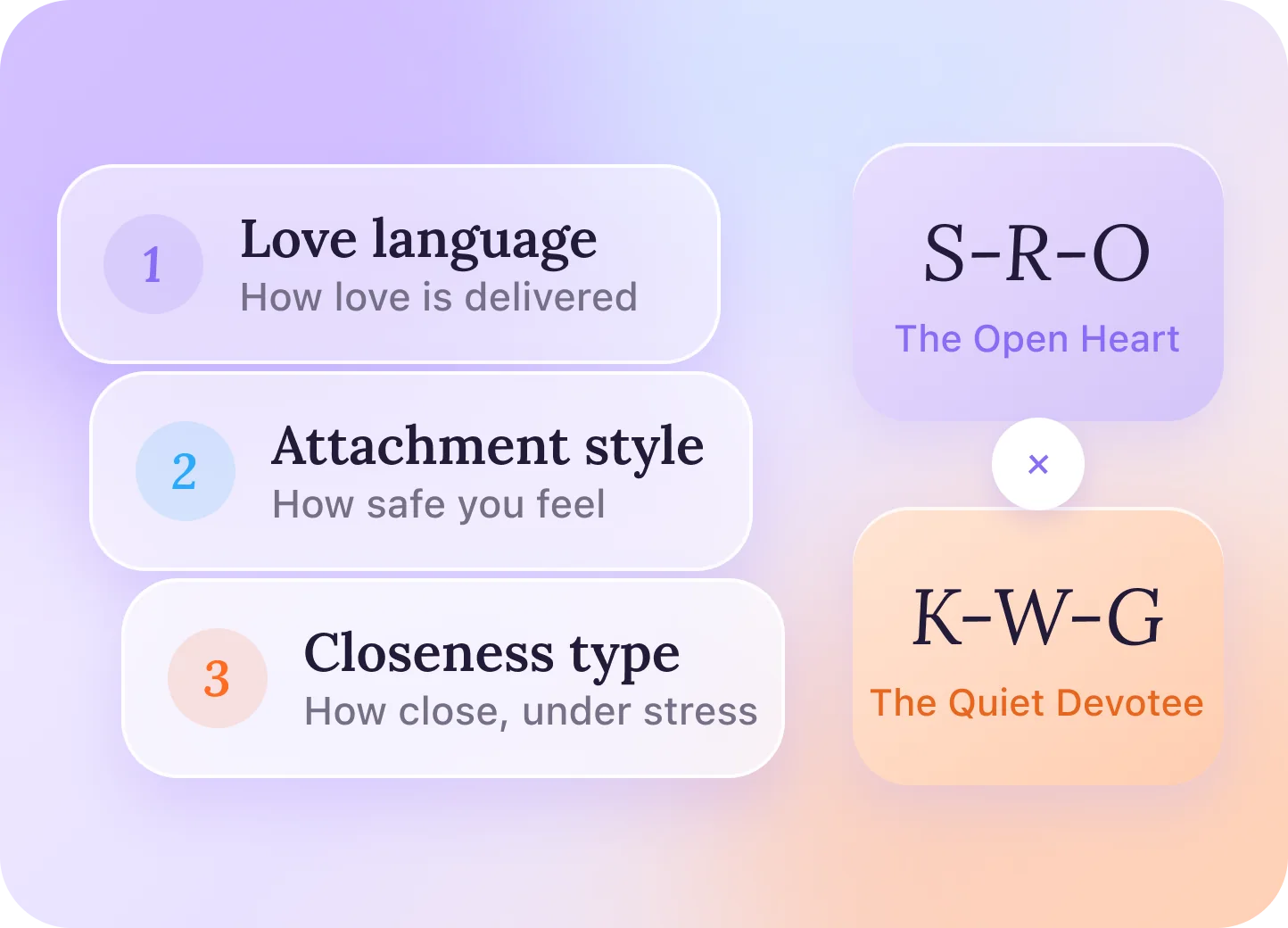
Each partner in the couple picks their love language in onboarding, and the shared reveal shows both. Together with your Connection Type, it forms your Relationship Profile, so habit 5 starts with real information, not guesswork.
Signals
Signals are one-tap messages: “I need a hug,” “I need a little space” and “I want to feel closer tonight.” They make habits 3 and 10 easier, because a paired partner can make a bid or ask for space without a big conversation.
AI Date Planner, countdowns and the couples wishlist
For habit 11, tell the AI Date Planner your city, budget and the kind of dates you like as a couple, spin the wheel when stuck, and save plans. Countdowns build anticipation. For habit 12, the couples wishlist remembers what your partner wants.
Translate My Emotions for the quick apology
For habit 9, paste your raw message and Translate My Emotions gives a 2-4 sentence version in your own voice: what happened, how you feel, what you need and a request. You can copy it, edit it or ask for softer. It never sends for you.
What we deliberately do not do. We never put clinical labels on you or your partner. Nothing is sent for you. Nothing from either partner’s private AI Companion conversations ever appears to the other partner. 4couple is not a replacement for professional help.
Frequently asked questions
How can I be a better partner every day?
The short answer to how to be a better partner is small, repeated habits instead of big gestures. Greet your partner properly, ask one real question a day, respond to their bids for attention, keep small promises and end each day connected. Gottman’s research describes this as “small things often.” Pick two or three habits, practise them for two weeks, and notice how your relationship as a couple changes.
What are small things to do for your partner?
Small things to do for your partner include a six-second kiss hello, putting your phone face down when they talk, thanking them for invisible work, remembering details they mention and checking in on their mood. None of these takes more than a few minutes, but repeated daily they tell your partner they matter and build lasting warmth in a couple.
How do I make my partner happy?
You cannot control another person’s happiness, but you can make them feel seen, safe and loved. Learn their love language and speak it, keep your word, apologise quickly when you get it wrong, and give them space without punishment. When those habits are steady, most partners feel happier and more relaxed in the relationship.
Is how to be a better boyfriend different from how to be a better husband?
Not really. The core habits are the same for boyfriends, girlfriends, husbands and wives: attention, reliability and warmth, repeated daily. What differs is your partner’s needs, their love language and what makes them feel safe. Every couple is different, so ask your partner which habits they would love most, and start there.
Is there an app that helps couples learn how to be a better partner?
Yes. 4couple is an AI relationship app for couples that turns small daily habits, like a shared question, a mood check-in and a one-tap signal, into an easy routine for both partners. Paired couples get a question of the day, a daily mood check-in with home screen widgets, love languages in the Relationship Profile, an AI Date Planner and a couples wishlist.
How long does it take for new relationship habits to work?
Many couples notice small changes, like warmer greetings and quicker repairs, within a couple of weeks. Deeper trust takes longer, because it grows from repeated reliability. Track two or three habits for two weeks, review together, then keep the ones that felt best to receive and add one more.
When should we get outside help?
If the same conflicts keep returning, if there has been a serious breach of trust, or if either partner feels unsafe or deeply unhappy, talk to a qualified professional. Daily habits support a healthy relationship, but they are not a replacement for professional help when a couple is stuck.
Sources and further reading
The research and frameworks behind this article, and where to read more:
Zach Brittle, The Gottman Institute: Turn Towards Instead of Away. John Gottman’s research on bids for connection and turning toward your partner.
Gary Chapman: The 5 Love Languages. The official site for the five love languages.
This article is general information, not therapy or medical advice. 4couple is a relationship app, not a replacement for a qualified professional. If you feel unsafe in your relationship, contact a professional or your local support line.
About the authors
Masha MaksymovychFounders Associate, 4couple
Writes about everyday relationship communication and how couples use 4couple day to day.
Yuliana RudayaHead of Organic Marketing, 4couple
Turns relationship research into practical guides couples can use the same evening.